


On the vast stage of human history, the species Homo sapiens has occupied a central and dominant role. From their origins in Africa to their global expansion, sapiens have woven an impressive narrative of achievements, challenges and evolution. The book “Sapiens: From Animals to Gods” by Yuval Noah Harari, published in 2014, has become a reference for understanding the history of our species, exploring its cultural, technological and social transformations.
The book begins with a discussion of the “Cognitive Revolution,” a key period in human history in which our ancestors acquired the ability to communicate through language and developed the ability to create and share myths, which allowed collaboration in larger groups. This revolution, according to Harari, was the basis for the creation of more complex and structured societies.
From this cognitive revolution, which began with the development of the ability to communicate, the primitive human being began its organization around social groups, capable of learning from the transmission of their knowledge, as well as improving the way of obtaining and share the resources necessary for the subsistence of its members.
This first great revolution allowed the expansion of human beings beyond Africa, causing the extinction of many species in the Arabian Peninsula and Eurasia.
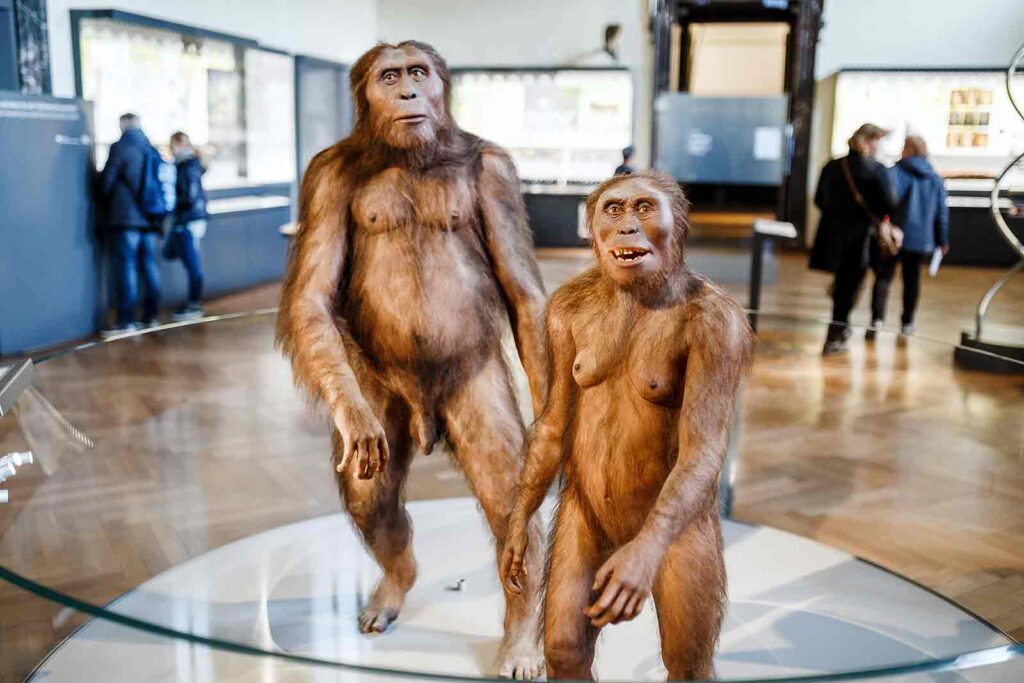
For the author, the ability to walk upright, having a larger brain than the rest of the animals, the ability to train the youngest through education and the mastery of fire, facilitated the evolution of the first humans towards Sapiens, producing the extinction of the other human species.
From this great first revolution, many centuries later, human beings learned to grow edible plants, allowing them to increase the amount of food available and their resources, since until that moment they fed from the resources he found and gathered.
<
This second revolution, according to Harari, constituted another qualitative leap in the evolution of the human being, thus during the so-called
"Agricultural Revolution", humans moved from hunting and gathering to agriculture and animal domestication. However, this transition, in addition to allowing a greater food supply, also provided the emergence of the concept of property, pitting people against each other for control of territories in which to settle. During this agricultural revolution, the development of social hierarchies took place, which established the work of each individual, where workers occupied the lowest social stratum.
The demographic boom produced as a consequence of the Agricultural Revolution, led to the appearance of the first writings and with them the organizations or empires, with the imposition of the first governments and their legislative systems.
Harari, in his book, also analyzes the “Scientific Revolution” that occurred 500 years ago, where a series of scientific and technological advances marked significant milestones in human history. Science allowed sapiens to understand the world around them more accurately, which in turn led to revolutionary technological and medical advances.
These advances consolidated the dominance of Homo Sapiens over the planet, producing a second demographic boom, which caused an increase in the consumption of resources and food.
The Industrial Revolution changed the way we live and work, ushering in an era of urbanization and economic growth, but also posing environmental and social challenges. The eagerness unleashed for new knowledge and the results it offers has motivated human beings to know the world around them, to control it and even to manipulate it.
The Industrial Revolution changed the way we live and work,
the use of plants to create medicines to cure diseases, inventions such as the wheel or the printing press, gave way
to an era of urbanization and economic growth, but also posing environmental and social challenges.
Harari emphasizes the importance of myths and beliefs in the cohesion and organization of human societies. Sapiens have the unique ability to create shared fictions, such as religions, nations, and currencies, which allow them to cooperate on a scale far greater than any other species.
The book also addresses current challenges facing humanity, such as climate change, artificial intelligence, and bioengineering. Harari warns that while we have made amazing progress, we have also created threats that could endanger our future as a species.
The unstoppable advance of technology and the increase in new scientific discoveries could lead human beings, perhaps in a short time, to a fourth great revolution.
“Sapiens: From Animals to Gods” gives us a fascinating perspective on the history of humanity and how we became the dominant species on the planet. Through cognitive, agricultural, scientific and industrial revolutions, we have radically transformed our way of life. However, it also reminds us that we face urgent challenges that require deep reflection and collective action. Ultimately, the book invites us to understand our past to make informed decisions about our future as sapiens.
“Sapiens from animals to gods” is a popular science book written by historian Yuval Noah Harari. It was published in 2011 and quickly became a bestseller, translated into more than 65 languages and with more than 20 million copies sold worldwide.
Yuval Noah Harari, Israeli writer and historian, graduated from the Hebrew University of Jerusalem in Medieval History and Military History, where he currently works as a professor, focuses his research on macrohistorical processes and the relationships between history and biology.
Sapiens is a popular science book that explores the history of humanity from an evolutionary and cultural perspective.
Harari is a popular author and his books have been praised for their academic rigor and ability to explain complex concepts in an accessible way. However, he has also been criticized for his pessimistic view of human history and his lack of depth on some topics. Harari is a controversial author, but his work has generated great debate about the future of humanity.
In 2016, Harari published “Homo Deus: Brief History of Tomorrow”, a work in which he reflects on the path that human beings will take as a species, seeking once the first three great problems of humanity, hunger, diseases, have been overcome. and wars, perhaps eternal happiness and overcoming death, in which the idea of dataism is expressed, a trend in which everything must be organized around the free circulation of data.
In his latest published work and “21 lessons for the 21st century”, a book of essays in which topics such as the technological challenge, truth and misinformation, as well as wars and religions, he investigates the most current and future problems. close to human beings and current civilized societies.