


Artificial intelligence (AI) has been one of the areas of greatest growth and development in technology in recent years. As Artificial Intelligence has become more advanced and pervasive in our society, it has begun to have a significant impact on the development of human intelligence
One of the most obvious ways in which Artificial Intelligence is affecting the development of human intelligence is through collaboration. Artificial Intelligence applications, such as virtual assistants and recommendation systems, are designed to work alongside people, allowing them to access information and resources more efficiently. This has led to an increase in people’s productivity and learning capacity.
For example, Artificial Intelligence can help students personalize their learning process, providing recommendations for readings and exercises adapted to their individual needs. Professionals can use Artificial Intelligence to analyze large data sets and obtain valuable information in fields such as medicine, science and industry. This collaboration between Artificial Intelligence and human intelligence is transforming the way we learn, work and solve problems.
Another important impact of Artificial Intelligence on the development of human intelligence is the expansion of our cognitive capabilities. AI systems can perform complex information processing tasks at speeds that far exceed human capabilities. This translates into faster access to information, more precise analyzes and a greater ability to address difficult, complicated problems or problems that require the processing of large volumes of information or the implementation of complex scientific formulations.
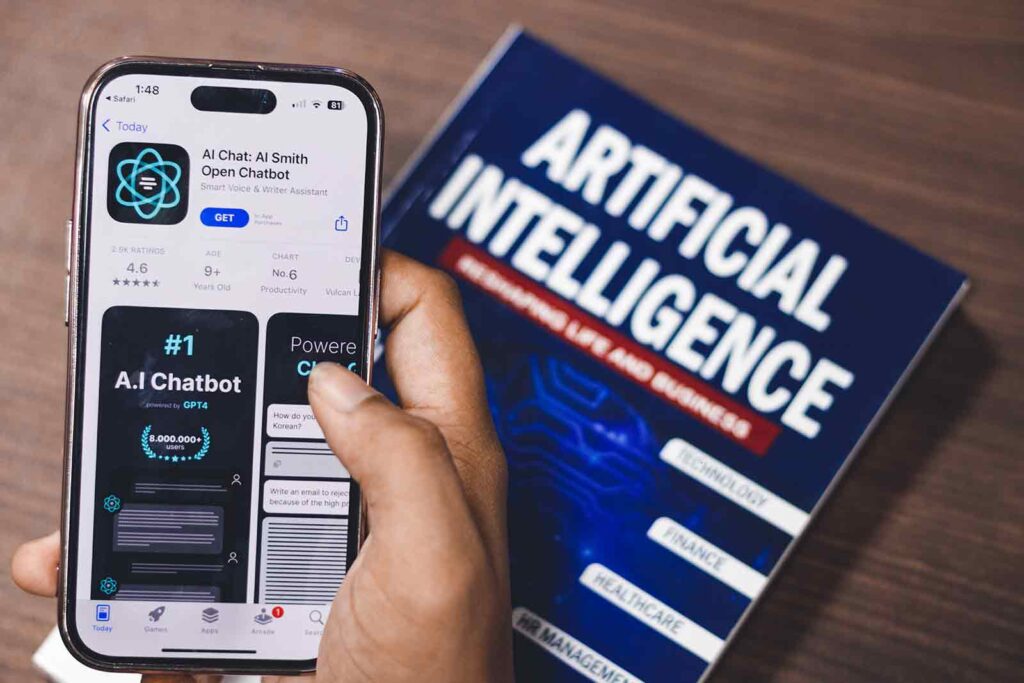
For example, Artificial Intelligence has proven effective in language translation, allowing people to communicate and access information in different languages more effectively. Machine learning algorithms can analyze large volumes of data in a matter of seconds, speeding up decision-making in areas such as finance and scientific research. In short, Artificial Intelligence is improving our cognitive abilities and allowing us to address more complex challenges.
But despite the obvious benefits, the impact of Artificial Intelligence on the development of human intelligence also poses important ethical and privacy challenges. The massive collection of data and the use of Artificial Intelligence algorithms to make decisions can cause problems of discrimination and bias. Furthermore, the automation of certain tasks can lead to job loss and increase the need for professional retraining for many people, whose job functions will be absorbed by these artificial intelligences.
Given these last considerations, it is essential that society addresses these ethical and privacy concerns as Artificial Intelligence continues to develop. This implies the implementation of appropriate regulations, transparency in the use of algorithms and consideration of the social implications that Artificial Intelligence can entail.
As Artificial Intelligence continues to evolve and collaborate with human intelligence, we may see a transformation in the way we understand and develop human intelligence. Education and training could focus on the effective use of Artificial Intelligence as a learning and problem-solving tool. Critical thinking, creativity and ethical skills could become even more valuable as Artificial Intelligence takes over routine and repetitive tasks.
However, if the development of artificial intelligence were maintained under parameters related to evolutionary processes of self-learning, it would perhaps not be unreasonable to think that at some point it would be capable of generating original proposals similar to those generated by a human being, which would allow solutions to be proposed. from prisms different from those presented up to that moment and even find solutions using premises not stated until now for a wide variety of problems.
For example, an artificial intelligence trained and oriented specifically towards the analysis of a particular disease could, at a given moment, based on its own learning, establish a hitherto implausible relationship with some element that would facilitate its cure, or for example, From the learning carried out to understand or verify the veracity of certain physical theories, find a new path that takes us towards an unknown theory or technology.
In any case, the development of artificial intelligence must also promote the development of human intelligence, which in the end must be understanding of the premises and statements issued by artificial intelligence, and there must always be effective, enriching communication that carries messages. understandable by both the sender and the receiver, in order to maintain a state of stability suitable for the operation of both.
The development of an artificial intelligence that intellectually surpasses the human being, or that simply discards it, considering it inferior through the reasoning carried out by its “neural algorithms”, could pose a serious danger to the development of the human species, therefore The evolution of artificial intelligence must be framed by rules, norms or limits that cannot be exceeded in any case, always maintaining the supremacy of human personality as a distinctive feature with respect to artificial intelligence.
The scope of the impact of Artificial Intelligence on human intelligence will be subject to the good use that human beings give to the latter.
With a simple look around us and at our own existence it is enough to verify that there are many situations, causes and feelings or motives that day after day incite us and countless people to make incorrect and in many cases unintelligent decisions. any of the aspects that surround their lives, however, dealing with aseptic intelligent entities in terms of feelings, empathy and evaluations, which develop analyzes and actions seeking the most optimized solution in achieving the result, it will be essential that scientists and technocrats, developers or trainers of these intelligences, are always as inhuman as them and of course more intelligent, in order to reduce the impact of artificial intelligence on human intelligence.
Ultimately, the impact of Artificial Intelligence on the development of human intelligence is an evolving process. As technology advances, it is essential that we consider how we can harness Artificial Intelligence to improve our lives while addressing the ethical and social challenges it presents. The collaboration between Artificial Intelligence and human intelligence has the potential to take us to new horizons of knowledge and capacity, but we must approach this future with security, responsibility and consideration.