



George Boole was born on November 2, 1815 in Lincoln, England. His father, John Boole, was a self-taught shoemaker with a keen interest in mathematics and science. George received a basic education at the local primary school, but was later primarily educated at home. Despite financial difficulties, Boole demonstrated a strong aptitude for mathematics and logic from an early age.
At the age of sixteen he taught mathematics at a private school and later founded his own. At the age of twenty-four, after the publication of his first writing, he was able to enter Cambridge, but had to decline the offer because of his duties towards his family.
In 1847, Boole published his most important work, “An Investigation of the Laws of Thought on Which are Founded the Mathematical Theories of Logic and Probabilities.” mathematical theories of logic and probabilities). In this work, his main contribution to logic was the creation of Boolean algebra, a mathematical system that uses variables and operations to represent logical propositions. This system revolutionized the field of logic and laid the foundation for the development of modern computing.
Boole’s great revelation was to associate symbols with logical elements and operations, the same functional structure as conventional algebra, so that the manipulation of these signs according to fixed rules produced logical results.
Boolean algebra is based on two main ideas:
Logical propositions can be represented by variables that can take two values: true or false.
Logical operations, such as “and,” “or,” and “not,” can be represented by mathematical operations. The logical operations of Boolean algebra are based on a series of rules from which it is possible to simplify any logical expression once represented mathematically, using the following logical operators;
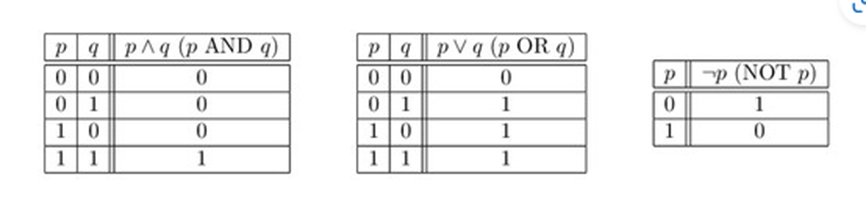
And the rules would be:
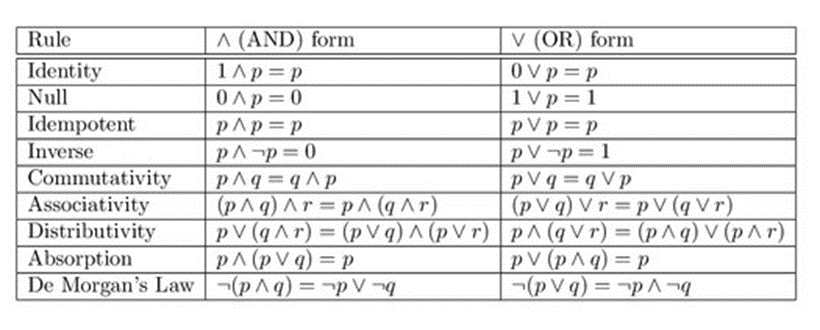
From these symbols and rules, propositions expressed in everyday language, for example “today I will go to the cinema” (P) and “tomorrow I will go to the cinema” (Q) can be written as mathematical expressions, as letters and numbers, these symbols generally having one of two possible positive or negative values, also obtaining from conjunction and disjunction operations only two possible results, positive or negative, thus P and Q, P or Q, are true or false , positive or negative, which allows them to be represented through a binary system: true or false; yes or no; 0 or 1.
In computer systems, the binary mathematical system is the most used numerical system, as it allows representing the possible states of the magnetic elements that are the basis of computers, which can only be on or off, states that are represented by the numbers 0 and 1, a binary system analogous to that exposed by Boole.
Boolean algebra allows mathematicians and computer scientists to work with logical propositions accurately and efficiently. It is used in a wide range of applications, such as:
- Digital circuit design: Modern computers work with electrical signals that can be represented as binary values (0 and 1). Boolean Algebra is used to design digital circuits that process these binary signals to perform calculations and make decisions.
- Programming: Programming languages use Boolean operators (AND, OR, NOT) to control the flow of program execution. Boolean Algebra allows programmers to write code that is accurate and efficient.
- Theory of computation: Boolean Algebra is the basis of the theory of computation, which is the study of the fundamentals of computing. It is used to analyze the complexity of algorithms and to test the correctness of programs.
- Artificial intelligence: Boolean Algebra is used in artificial intelligence to represent and manipulate knowledge. It is used in machine learning systems to train models that can make decisions and solve problems.
- Other areas: Boolean Algebra is used in a wide range of other areas of computing, such as computer networks, computer security, and cryptography.
Boolean Algebra is a fundamental pillar of current computing. It is an essential tool for digital circuit design, programming, computing theory, artificial intelligence and other areas. Without Boolean Algebra, modern computing would not be possible.
For example, computer processors are made up of millions of transistors that operate with Boolean logic. Search engines use Boolean algebra to index and retrieve information from the web. Computer security systems use Boolean algebra to detect and prevent intrusions.
Boole’s work in logic was not limited to Boolean algebra. Boole also made important contributions in other areas of mathematics, such as differential equations, analysis, and probability theory. In 1854, he was appointed professor of mathematics at Queen’s College, Cork, Ireland, where he remained until his death in 1864.
Thus, he contributed to the field of mathematical analysis with his work “A Treatise on Differential Equations”, in which he developed a method for solving linear differential equations, which is known as Boole’s method, and is used still today. He also made contributions to geometry in his work “An Elementary Treatise on the Calculus of Finite Differences”, developing a method for calculating areas and volumes using finite difference calculus.
George Boole’s work has had a profound impact on a wide range of fields, from logic and mathematics to computer science and engineering. He is considered one of the most important mathematicians and logicians of the 19th century, and his legacy continues to inspire new generations of scientists and researchers.