


The Role of Almería on the big screen has captivated filmmakers and viewers alike with its stunning desert landscape, pristine beaches and historic architecture. The city of Almería, located in the region of Andalusia, Spain, has been a film filming location with great impact on the film industry. Over the decades, Almería has served as an iconic setting for countless film productions, from spaghetti westerns to Hollywood blockbusters.
Almería’s Mediterranean climate, with its blue skies and white sand beaches, is one of the main attractions for filmmakers, making it an ideal place for filming films of all kinds.
Although the first feature film was filmed in Almería in 1952, it was in 1956 after the filming of the film eye for eye by director André Cayatte, shot in Tabernas and Turrilla, that Almería began to be heard in international cinematographic environments.
During the 1960s, Almería gained international fame as the “capital of the spaghetti western.” Directors such as Sergio Leone chose the unique landscape of Almería to film emblematic films such as “A Fistful of Dollars” (1964) and “The Good, the Bad and the Ugly” (1966). The deserts, canyons and abandoned towns of the region successfully recreated the setting of the American Wild West, setting a new standard for the genre.
In the 1980s, Almería began to diversify its film offering. The province was the setting for films of other genres, such as “Indiana Jones and the Last Crusade” (1989), “The Mummy” (1999) and “Pirates of the Caribbean: At World’s End” (2007).
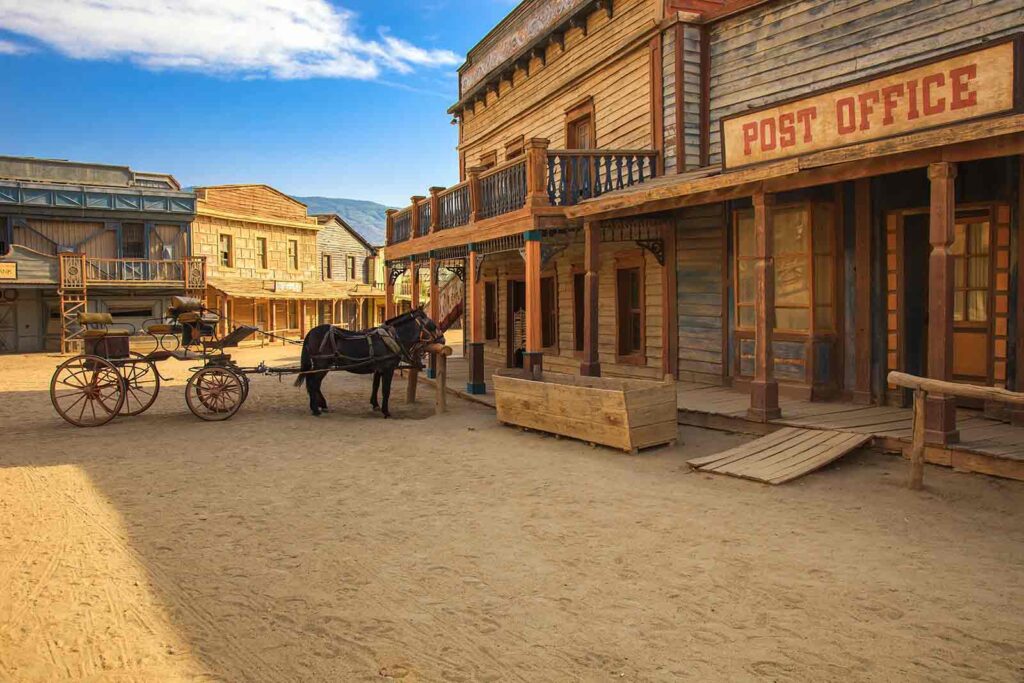
Almería has a great variety of landscapes, from arid deserts to picturesque beaches and historical structures, which have allowed us to represent a wide range of places in different periods and settings, from the Old West to ancient Egypt , offering through its natural landscapes and settings, a great versatility of idyllic spaces for the production of all kinds of films.
In addition to spaghetti westerns, Almería has been chosen as the setting for many other notable films. David Lean’s film “Lawrence of Arabia” (1962) used the Tabernas Desert to recreate the vast landscapes of the Middle East. Steven Spielberg’s “Indiana Jones and the Last Crusade” (1989) filmed some of its scenes in the region, transforming the town of Alcudia de Monteagud into a location in the fictional world.
Almería’s impact on the film industry has also had an effect on tourism. The natural beauty and historic sites that have become iconic on the big screen attract travelers interested in exploring the places where their favorite movies came to life. This has led to a rise in film tourism, where visitors can tour the same places as their screen heroes.
Some of the most popular places to shoot movies are El Desierto de Tabernas, a desert of more than 280 km2, Mónsul beach with white sand and crystal clear waters and Cabo de Gata, a 20km cape that has been the setting for films such as “The Minimal Island” (2014)
Despite its success as a filming location, Almería has faced challenges over the years, such as competition from other locations and the need to preserve historical sites. However, the region remains a popular destination for filmmakers and offers opportunities for future productions.
With the creation of the Almería, land of cinema awards or the Almería en Corto International Festival, which received more than 3,000 short films in competition in 2012, initiatives were generated that sought to return cinema to its rightful place in the city, also allowing us to remember illustrious actors such as Omar Sharif, Raquel Welch or Faye Dunaway, who had the honor of participating in films shot in the natural settings that Almería offers to the world of cinema.
In recent years, Almería has experienced a renaissance of cinema, being the place chosen as the setting for numerous films, such as “Exodus: Gods and Kings” (2014), “Game of Thrones” (2011-2019) and “Wonder Woman 1984” (2020).
Almería has left an indelible mark on the history of cinema as a unique and versatile filming location. Its transformation into an Old West, a World War II setting or an ancient Egyptian kingdom on the big screen has led the region to be recognized worldwide. As cinema continues to evolve, Almería remains a reminder of the importance of authentic and distinctive places in creating memorable cinematic narratives.
In recent years, there have been many proposals that have emerged related to the places, places and settings in which large productions have been filmed, which have allowed the creation of all types of tourist and cultural tours. and informative through the most cinematic Almería, as proof of this, we recommend the following cinema guide
Film Landscapes, Almería de Pelicula