


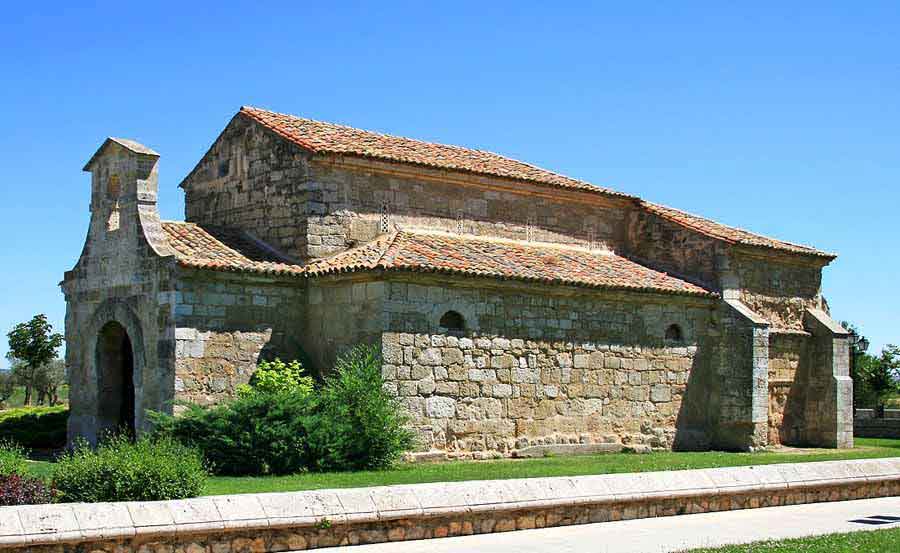
The church of San Juan de Baños, a testimony of history, is an architectural and spiritual treasure located in the town of Baños de Cerrato, in the province of Palencia, Spain. This ancient religious building is a sample of the rich history of the region and has witnessed numerous events throughout
the ages.
The Church of San Juan de Baños has its roots in the Visigoth era, which spans from the 5th century to the 8th century AD. and according to the inscriptions that it still preserves, it was built in the middle of the 7th century, although it has been the subject of numerous reforms and restorations over the centuries. Its architectural design is a significant testimony of the religious architecture of the Visigoth kingdom, standing as a clear example of connection with the architecture of the late Roman Empire. It was declared a National Monument in 1897 and is considered the oldest active Christian church in Spain. .
With a basilica plan, with three naves and three apses, built with limestone and brick, the central nave stands out with respect to the lateral ones due to its greater height, being separated from them by four horseshoe arches , with semicircular apses decorated with mosaics.
However, one of the most notable features of the church is its portico, which dates back to the 7th century and is considered one of the best examples of Visigoth art in Spain, which has a large entrance in the form of a portal, which shows in Its outer part is a horseshoe arch carved in stone with a border of geometric motifs.
In the interior you can see the Visigothic arches on reused marble columns, with the yellow ocher capitals that contrast with the ashlars of the hard limestone walls, it has four marble columns with capitals
Corinthian, although there are also original Visigoths, and horseshoe arches of Visigothic design, which support the arches separating the naves, in the shape of a horseshoe, as well as that of the portico and the triumphal, with the typical Visigothic canon.
The modifications that were made centuries after the temple was erected were several, the most notable being the one that affected the side apses, changing its vaults to ribbed vaults and also modifying the roof which now had a gabled roof.
The Church of San Juan de Baños is an important cultural and religious symbol in the Palencia region and throughout Spain. Its historical value lies in its antiquity and its ability to show the evolution of architecture and art over the centuries, it represents the fusion of Roman and Christian architectural traditions, it is a testimony to the power and wealth of the Visigothic kingdom. , and is a testimony to the continuity of the Christian tradition in the Iberian Peninsula.
The sculptural decoration is relatively classic, traditional and austere, with the chevet preceded by a transept followed by a triple apse, with the triumphal arch displaying the plaque that dates the building, decorated with borders like the portal.
A bronze reproduction of the well-known Crown of Recesvinto can be found in the presbytery of the Church of San Juan de Baños.
To the right of the Basilica of San Juan, is what is known as the Recesvinto Fountain, because its waters have restored health to this monarch, since according to tradition the reason why The fact that the Visigoth king ordered this temple to be built comes from the miraculous recovery from his kidney problems, when after a battle against the Basques, he stopped to rest in this town because he was sick and during his rest, he drank water from a very nearby spring. , thanks to which he recovered, deciding as a way of gratitude to erect the temple that we see today.
This spring was known since ancient times and it seems that it always had a reputation for making healthy water flow, so in Roman times there was a temple in this area dedicated to the god Aesculapius, already in Christian times the place was sanctified, dedicating it to Saint John Bautista, maintaining today an abundant flow.
The fountain is built with two horseshoe arches that access a type of tank that is where the spring flows, considered one of the few hydraulic and civil works of pre-Romanesque architecture, of which the original remains of the cistern that were preserved are preserved. used for immersion baths.
The architecture of the Church of San Juan de Baños is a testimony to the wealth of influences over the centuries. The Visigothic portico is an impressive example of the architecture of that era, characterized by horseshoe arches and geometric decorations.
The conservation and restoration of the Church of San Juan de Baños has been a continuous effort over the years. Given its age and historical and cultural importance, it is essential to preserve this architectural treasure for future generations.
Local and national organizations, as well as the government, have been involved in restoration and maintenance projects to ensure that the church remains in good condition and can continue to be appreciated by generations to come.