

From extended and traditional families to today’s modern and diverse families, the evolution of families in Spanish society has experienced a series of cultural, economic and social transformations that have shaped the way we understand and live the family today. The structure and dynamics of families in Spain have undergone a notable evolution over the centuries.
If we consider that the first groupings of human beings must have occurred for collaborative convenience to obtain food, we can affirm that the precursor unit of the concept of family in an environment of sexual promiscuity was the woman, the only procreator of the clan and therefore the only certain guarantor of the consanguinity of her children. In the evolution of this rudimentary “family” organization, patriarchy appears where the man is responsible for the education of his sons and the women for the education of their daughters, more out of their own need than by design of a strategy or organizational structure. . At that time the men hunted, fished and gathered, while the women took care of the fire, planting and weaving.
From the evolution of the clan structure in smaller units, formed by the grouping of several monogamous communities, where pairing arose from a primary sexual need, maintaining their consanguinity as a link between individuals. , the first concept of a matriarchal or patriarchal family was born many years later. From these and continuing with the evolution of the family, the family emerged as an individual monogamous unit, where the man became the owner of the family, recognizing the paternity of his children, and the concept of private property emerged, with the aim to facilitate inheritance for children.
In later, much more advanced societies, such as Egypt, Hebrew or classical Greece, the family continued to evolve, based on marital unions, in which the husband was authorized to have secondary wives, in case the main wife did not. I could have children. This concept of family was based on the idea of procreation, the preservation of the family, and in many of them, the figure of the woman was relegated to the subordination of the figure of her husband.
For much of Spanish history, the dominant family structure was the extended, agricultural family. In this model, several generations lived under the same roof and They shared educational, economic and safeguarding or protection responsibilities. The families were large, with multiple children, grandparents and other relatives. This system of extended families adapted to the needs of an agricultural economy in which the family labor force was essential for the sustenance of all its members.
The arrival of the Industrial Revolution in the 19th century brought with it significant changes in the family structure in Spain. As people moved to cities in search of of employment in factories, there was a decrease in the extended family and an increase in the nuclear family. Families became smaller, with parents and children living together, and a shift in gender dynamics occurred as women began to work outside the home.
During the dictatorship of Francisco Franco (1939-1975), a traditional and conservative family model was promoted in Spain. The Franco regime defended the family as a sacred institution and advocated the subordination of women to the role of wives and mothers. Contraception was prohibited, and state control over morality and family life was rigorous.
With the death of Franco in 1975 and the transition to democracy in Spain, significant changes occurred in family structure and dynamics. The 1978 Constitution established gender equality as one of its founding principles, leading to a change in gender role expectations and an increase in women in the workforce. Social acceptance of contraception and divorce also increased, allowing for greater autonomy in family decision-making.
In today’s Spain, the family has evolved towards greater diversity. Although the nuclear family remains common, single-parent families, stepfamilies, childless couples, and same-sex couples have also become more common. Family structures have become more flexible and adaptive to individual needs and choices.
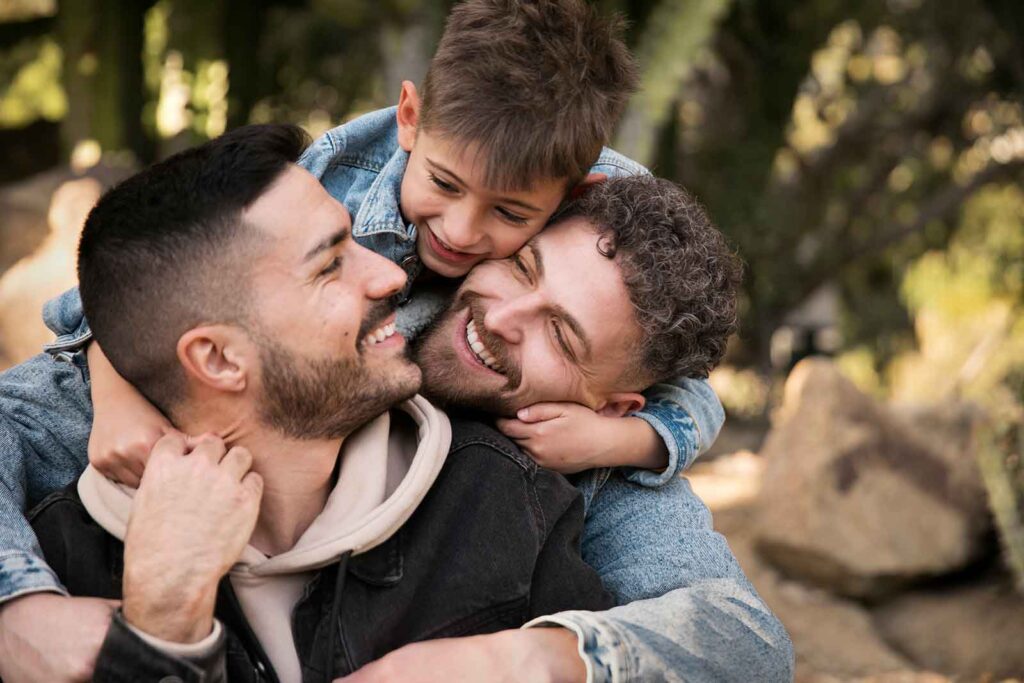
Thus currently, families can be single-parent, made up of a single adult member responsible for the children, normally arising as a result of divorce, widowhood, or one’s own decision to be a father or mother. single woman. Two-parent families made up of two adults and their children can be heteroparental (two people of different sex) or homoparental (two people of the same sex), and be established without the need to celebrate marriage.
In turn, blended families are those formed by two members, where one of them already has children; they are normally produced from single-parent families.
The family today is the first organization, or group to which an individual belongs, since normally from the moment of birth it is integrated into its structure. The family constitutes the basis of any modern society, and is found in all types of cultures and societies, it constitutes the basis for the transmission of the values of society and is the precursor of the education of the individual from his earliest age.
The family is an active participant in the transmission of respect for individuality, honesty, justice, tolerance, commitment, responsibility and affection, as well as the continuity of traditions and customs.
However, one of the main challenges facing the contemporary family is the balance between work and family life. The full incorporation of women into the labor market has generated the need to create and develop egalitarian conciliation policies, so that the members of the family unit themselves, regardless of their gender, can freely decide how and who they will share. Members perform tasks with respect to their children or elders, tasks such as child care, family care, medical care, or educational care.
For this reason, in the not too distant future and as a consequence of the needs of the evolution of families, it will be common to make working hours more flexible and the existence of a regulation regulating conciliation situations that could be presented to any current family unit.
Despite changes in family structure, the family continues to be a crucial support network in Spanish society. Family relationships remain strong and play a vital role in emotional and financial support. In times of crisis or need, it is common for Spanish families to come together to help each other.
The evolution of the family in Spain reflects the broader transformations in society, the economy and culture throughout history. From extended farm families to today’s nuclear and diverse families, the family has demonstrated its ability to adapt to changing social and economic realities. As Spain continues to move forward into the 21st century, the family will continue to play a central role in people’s lives and in society as a whole.