


This iconic city, converted into a paradise of skyscrapers and opulence in the desert, located in the United Arab Emirates, has emerged as a living testimony of modern engineering and economic power. Despite its location in the middle of the arid desert, Dubai has managed to transform itself into a vibrant and prosperous metropolis that attracts tourists and businesspeople from all over the world. Its history dates back decades, when it was just a fishing village on the shores of the Persian Gulf.
The history of Dubai begins 5,000 years ago in the Stone Age, with the first settlements of nomadic shepherds, who lived by raising livestock, collecting dates and fishing.
The arrival of Islam from 630 AD. It favored trade in the region, attracting the attention of merchants from India and China until the arrival of the Europeans in the 15th century, interested in controlling the trade routes, first the Portuguese and a century later the English, who formed a protectorate. for almost two centuries.
In the early 19th century, the Al Abu Falasa clan settled in Dubai, remaining under Abu Dhabi control until 1833, when it was taken over by the Al Maktoum dynasty (descendant of the House of Al-Falasi) taking control of Abu Dhabi. , who established a hereditary monarchy and became the first emir of the emirate,
making pearl extraction and fishing a main part of the inhabitants’ lives.
Years later, with the signing of several agreements with the English, it was possible to guarantee the monopoly in the capture of pearls, in addition to guaranteeing in 1892 the protection of the United Kingdom against any attack by the Ottoman Empire.
With the opening of trade to other countries and the elimination of taxes on imports and exports, Dubai Port became a maritime platform for international trade.
With the onset of the Great Depression, the rise of Japanese cultured pearls in the 1940s, and the decline in trade as a result of World War II, the protectorate’s economy collapsed.
The United Arab Emirates was conceived as a federation of nine states, including Bahrain and Qatar, however, by 1971 only six states had annexed it, finally becoming a federation of 7 states in 1972 and giving rise to the birth of the United Arab Emirates. Modern United States, and confirming the independence of the United Kingdom.
After thirty years of prospecting and research, oil was discovered in Dubai in 1966, promoting its growth and expansion, and the export of crude oil began in 1969 after the creation of the Abu Dhabi National Oil Company. Dhabi, supervisor of oil production. The discovery of oil caused a massive influx of foreign workers, mainly Indians and Pakistanis. As a result, the city’s population between 1968 and 1975 increased by more than 300%, according to some estimates.
The development reached its peak under the mandate of Sheikh Rashid bin Saeed Al Maktoum, who promoted the development of programs aimed at improving the quality of life of his people with the income obtained from oil, giving rise to the urban boom with the beginning of the construction of infrastructure and buildings that exist today.
However, as the discovery of oil transformed the region, Dubai embarked on an ambitious economic and development mission to become a world-class financial and commercial center. In the 1960s the discovery of oil allowed Dubai to invest in infrastructure and develop its economy to, through bold strategic planning, diversify its economy and reduce its dependence on oil.
In recent decades, Dubai has achieved spectacular growth thanks to its avant-garde vision and the implementation of innovative projects. The development of impressive skyscrapers became a symbol of Dubai’s growth and opulence. The construction of iconic skyscrapers such as the Burj Khalifa, the tallest building in the world, exemplifies the city’s innovative architecture, whose buildings are testaments to Dubai’s entrepreneurial spirit and ability to overcome challenges, which has led to Dubai to the top of the list of tourist destinations and has established its reputation as a place for opulence and luxury.
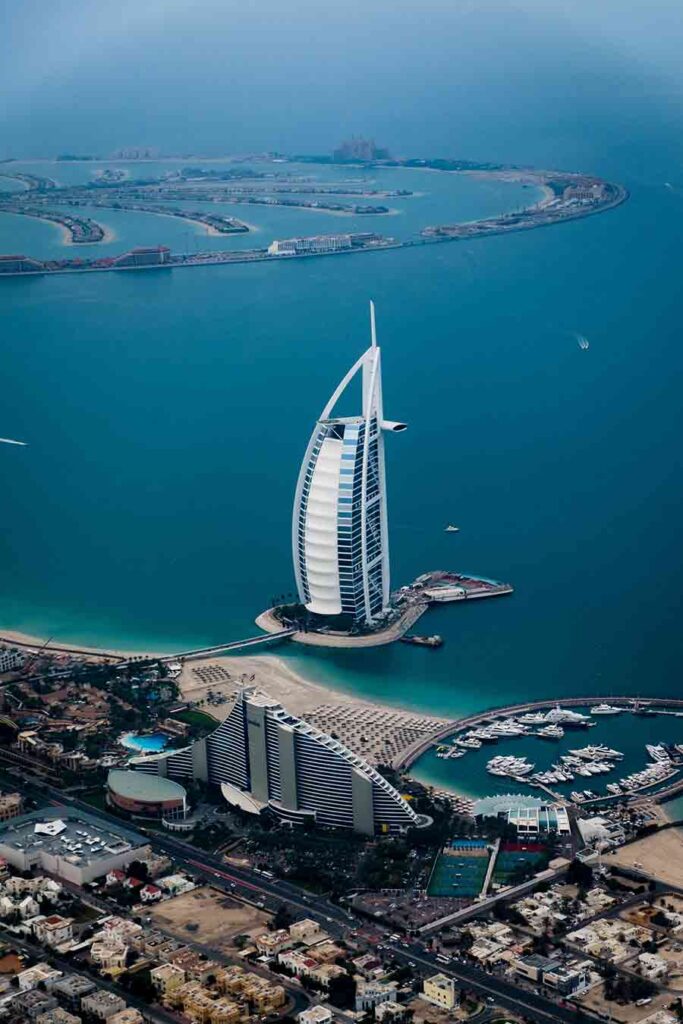
In addition to its impressive skyline of skyscrapers, Dubai has invested in various industries to boost its economy, the city has become a center for luxury tourism, with world-class hotels and resorts that attract visitors from all over the world, as well as a center of international trade and business, hosting numerous companies and commercial exhibitions.
Dubai is home to a number of attractions and iconic places that reflect its culture and heritage. The Burj Al Arab, a luxurious sail-shaped hotel, and the Palm Jumeirah, an artificial island shaped like a palm tree, are just a few examples of the creativity and determination that have shaped Dubai’s urban landscape.
Dubai’s continued development has been driven by the ambitious vision of its leaders, who have implemented progressive policies to attract foreign investment and foster innovation. The creation of free zones and technology parks has led to the arrival of international companies and established Dubai as a global business and financial center. The city has also invested in education, technology and sustainability, positioning itself as a leader in these areas.
In addition to economic growth, Dubai has also made efforts to preserve and promote its cultural heritage. The city is home to a number of museums and galleries showcasing the art and history of the region, including the Dubai Museum and Alserkal Avenue, a contemporary art district.
Dubai today is a vibrant and cosmopolitan place, where wealth and modernity combine with the rich history and culture of the region. Although it has experienced extraordinary growth in recent decades, Dubai has not forgotten its roots and has managed to preserve its cultural heritage.
Dubai has evolved from a small fishing village to a paradise of skyscrapers and desert opulence. Its history is marked by its ability to adapt and its determination to remain at the forefront of innovation and economic development. Today, Dubai remains a fascinating destination that offers a unique experience for both tourists and entrepreneurs seeking new opportunities on the desert horizon.