

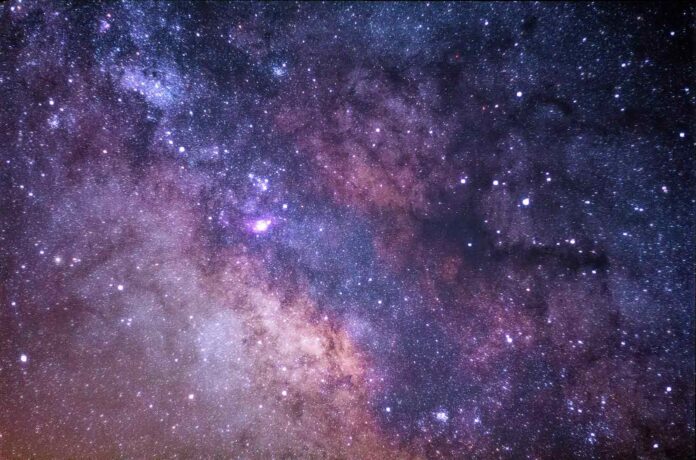

Who tells us that we are not part of a group like Russian dolls or mamushka?
Perhaps some human questions, from a philosophical point of view (who we are, where we are going, where we come from…), do not need an answer.
And if… Are human beings parts or elements within other elements interacting with each other and with them, like, for example, electrons in an atom?
Human beings have spent more than 6,000 years, since the Sumerians back in 4,000 BC, trying to answer questions such as: Who are we? Where do we come from? Where are we going? Why are we here? What happens after we die?
Many have tried to find answers to these questions from different perspectives and points of view, scientific, religious, philosophical
However, if we look around us, nature, the elements that accompany us through chemistry, the elements that form us through biology, and how we relate and our environment relates thanks to to physics, perhaps we can come up with curious ideas at least.
For example… And if each human being were really a particle of an element called earth, with which they have to interact to improve or worsen, but always to modify this main element… ., and if this natural element were another element within another larger element, such as the Milky Way, which in turn is an element within another element…, and so on…
If we observe a plant, for example, with current knowledge, we can decompose it into elements, roots, stem, leaves…, considered vegetative organs, but not elemental, all of them made up of smaller particles , called tissues, such as meristems or parenchyma, which in turn are made up of cells very similar to ours, with DNA in their nucleus, but with some differences, such as chloroplasts, organs of the plant cell responsible for carrying out photosynthesis.
Perhaps our skills and knowledge limit us enough to not find the answers to the most basic questions of human beings.
These plant cells are also made up of mitochondria, nucleolus, chromosomes…, which in turn are made up of smaller cells….
If we present ourselves as the mitochondria, the human being could well be an entity with obligations and duties towards its element, so that even without knowing it, it collaborates in some way to modify, positively or negative, the environment in which he develops and lives.
Being limited in its functions and abilities, it is also limited in knowing or achieving knowledge or the existence of certain higher organs, just as the mitochondria inside a chloroplast would be unaware of the existence of a mitochondria of the nucleolus, or how the chloroplast would be unaware of the existence of the parenchyma and of course the leaves, being limited by its functionality and its environment.
It is possible that human beings cannot know beyond a perceptible limit, just like Russian mamushkas, dolls that are hollow inside and contain other smaller dolls. Each doll is smaller than the last, until you reach a very small doll that has nothing inside. In a metaphorical sense, Russian mamushkas represent the way in which humans know the world. There is always something beyond what we can see or touch. There is always a new frontier to explore.
However, it is also possible, although not probable, that the human being will settle for living in a limited world, adapted to what he knows and stop searching for what he does not know. This could happen, for example, if the human being were faced with a hostile or dangerous environment, in which case, they could choose to take refuge in their known and safe world, although it could also happen if the human being loses hope or motivation, choosing to give up exploring a world that seems too big or too much. complex.
In any case, if human beings did not have the knowledge or resources necessary to explore the world, it is likely that they would have to settle for what they know, and assuming a universe like that of the mamuskas, it would be A lot of knowledge and resources are necessary to understand the secrets of the outermost layers, making it impossible for human beings to answer many of their great and eternal answers.
Therefore, perhaps there are questions that never find answers, since the human being is limited to the environment in which he develops, in this case the earth, with the Milky Way being optimistic, and the universe being very optimistic. current known.
However, in recent years there have been constant advances in different areas of science and technology, confirming the innate desire to learn and know those around us, although it still seems that Indeed, we can be a component within another component called the universe, which, like a higher organ, needs our efforts and our evolution for itself to grow and evolve, on very different time scales.
In the world around us, there are species of animals with a minimal life expectancy compared to the average life expectancy of human beings, however during that life, these species must perform a series of tasks to fulfill their role in the structure of life, for example, bees have an average lifespan, depending on their function within the hive, which can range from 6 weeks for workers, or six months for drones, to three years for the queen. , but each one must fulfill their functions, to ensure the future of their companions and the permanence of the hive.
Something like this could happen with us humans, as an integrated element within a larger structure like the one set out above, where our life span would be tiny with respect to the times managed or scaled at an astronomical level, where things happen in measured temporal intervals. on different scales. Just as perhaps for a bee six months is our entire life, for a universe our life span is equal to that of the bee.
Just as the human being is integrated into an initially planetary environment, and just as it is formed by internal structures structured on other structures or components, which in turn are supported or developed on other components , and thus descend to the smallest known element, at the subatomic or particle level, where each of these performs a function so that the higher structure in which it is integrated can in turn perform a new function and so on in an ascending order. by the elements structured from the structured elements of lower levels….could continue raising levels as much as our knowledge allows us initially and as much as we want to imagine later.
The members of each level may be limited in knowledge by the limits of the structure to which they belong, and within which they develop their functions, preventing the scope of the knowledge necessary to understand the functioning of the higher structure, like a game of dolls. mamuskas outside.