


Nowadays it is popular to use bottle caps to play soccer, however in the 19th century, no one thought that an invention intended to cover bottles would be used many years later to play soccer.
However, in the 19th century, medicinal drinks were prescribed whose curative effect was based on maintaining the bubbling that the carbon dioxide that was part of its composition produced; for this it was necessary to have a suitable stopper.
In 1981 Pinter invented the crown cork stopper, which was soon known as chapa, which arrived in Spain in 1921, maintaining its design over time, modifying only the material in which they are constructed, replacing the cork in the designs. initials with a piece of plastic or metal, these being the preferred ones for the game of soccer.
Before starting to play, the normal thing was to prepare it, for this some were ground with hammer blows, either to open its crown to different degrees a little, medium or a lot and facilitate the elevation of the dice that would act as a ball, or to close it. the crowns and obtain a rockier veneer, or correct defects that it had suffered in the process of opening the bottle to which it belonged.
Subsequently, it was necessary to give them a certain weight, filling their interior with plasticine or candle wax, and other heavier materials such as lead could not be used.
Once prepared, all of the same team could be painted uniformly and even small representations of the players from official teams could be pasted on the top using sticker cutouts.
The goalkeeper was prepared using a small matchbox of approximately 3.6 cm, which was filled to provide weight with any material that deformed its structure, the use of candle wax being common.
The team was made up of eleven players, a goalkeeper (matchbox) and ten field players (capas), with a maximum of four substitute capes.
As a playing field, any surface was used where the plates could move correctly, marking the playing field correctly, a rectangle measuring between 155 and 200 cm long by between 100 and 130 cm wide, using goals made of 15 cm long by 5 cm high, with a fixed net that prevents the exit of the ball used as a ball once it has entered the goal.
The duration of the match was established in two equal periods of time, with a break of approximately five minutes.
The movement of the plates is carried out by hitting any finger on the plate, dry and clean, without being able to drag the plate at any time, which if this occurs would seriously constitute having committed a fault, the same sanctioning punishment would be applied to any action. of the participant in which he hit the ball or an opposing player with his finger before, during or after the touch.
If a blow is made on the sheet and it does not move, the blow is considered not made, allowing a new blow to be carried out.
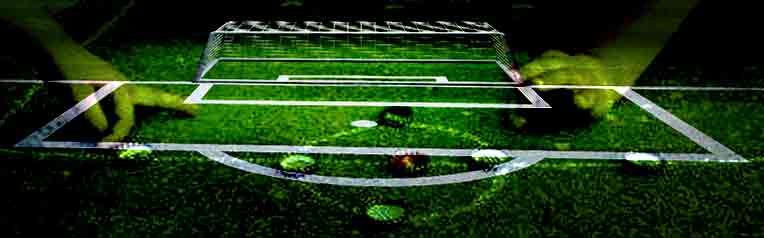
Once the game has started, each participant has a turn to move alternately, being able to make a touch or hit on a sheet of their team, being able to take successive turns whenever the ball touches a sheet of their own team, this action being called a pass. , thus in an unlimited manner until a pass fails, a shot occurs, a foul occurs, or the ball leaves the field of play.
Players will be able to arrange themselves on the field of play as they prefer following game system criteria, being able to reposition themselves at half-time, and players being able to return to their initial positions, whenever the game is stopped.
To take the shot on goal, it was necessary to warn the attacker by loudly saying “on goal”, so that his opponent could place his goalkeeper and also loudly warn when he was ready to receive the shot, resulting in a goal. when the ball completely entered the goal, the team that scored the greatest number of goals being the winner of the match.
Currently there are specialized clubs and championships of this popular game in various places throughout Spain, such as in Las Palmas de Gran Canaria, in La Laguna in Tenerife, Madrid or Málaga, which are associated in a federation, through which they have developed an official regulation.
The member teams of the federation have their own image (equipment, shield…), fields and playing facilities, and participate in one or several tournaments, some regional, others provincial and even national, promoted by the federation itself, with several federated players.